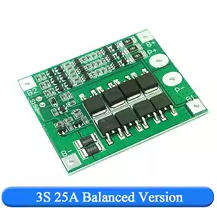
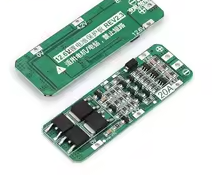
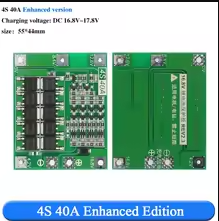
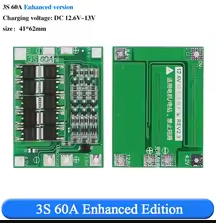
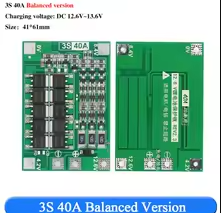
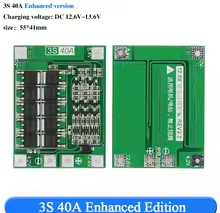
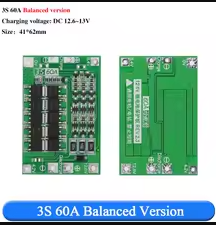
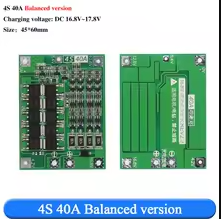
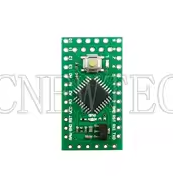
3S 25A Balanced BMS Lithium Battery Protection Board
Battery Management System with Cell Balancing for 3Cell Liion Packs
The 3S 25A Balanced BMS is a highperformance battery management system designed to protect and balance 3series lithiumion battery packs. Featuring 25A continuous discharge current, 4050mA balancing current, and comprehensive protection, this board provides reliable protection against overcharge, over-discharge, overcurrent, and short circuits. Perfect for power tools, portable devices, and DIY battery projects [citation:1][citation:2][citation:3].
Designed for 3.6V/3.7V Liion and LiPo battery cells (18650, 26650, polymer)
Supports 3S configuration with 12.6V full charge voltage
Not suitable for LiFePO4 batteries Liion/Li-Po only [citation:7][citation:10]
Technical Specifications
| Parameter | Value |
|---|
| Battery Configuration | 3S (3 cells in series) |
| Supported Battery Types | Liion / LiPo (3.6-3.7V cells) |
| Full Charge Voltage | 12.6V - 13.6V |
| Continuous Discharge Current | 25A [citation:1][citation:6] |
| Instantaneous/Surge Current | 34-40A [citation:1][citation:3] |
| Continuous Charge Current | 25A [citation:6] |
| Balancing Current | 40-50mA (passive balancing) [citation:3][citation:5] |
| Overcharge Detection | 4.25-4.35V ±0.05V per cell [citation:3][citation:5] |
| Over-discharge Detection | 2.3-3.0V ±0.05V per cell [citation:1][citation:3] |
| Short Circuit Protection | Yes (auto recovery) [citation:1][citation:5] |
| Quiescent Current | < 30uA [citation:1][citation:3] |
| Operating Temperature | -40°C to +50°C [citation:1][citation:3] |
| Dimensions | ~56mm x 45mm x 4mm [citation:1][citation:2] |
| Mounting | Through-hole pads |
= Key Features =
Cell Balancing 4050mA passive balancing ensures cells remain at equal voltage for extended battery life and performance [citation:3][citation:5]
High Discharge Capacity 25A continuous discharge with 3440A surge support for demanding applications [citation:1][citation:3]
Comprehensive Protection Overcharge, overdischarge, overcurrent, and short circuit protection with auto recovery [citation:4][citation:7]
Low Standby Current - Only 30uA static current minimizes battery drain during idle periods [citation:1][citation:3]
Auto Recovery - After short circuit or overcurrent protection, automatically recovers when fault is cleared [citation:1][citation:4]
Long Service Life - Effective lifespan of over 30,000 hours [citation:1][citation:3]
= Applications =
- Power tools and electric drills
- Portable power supplies and generators
- LED lighting systems
- Solar-powered systems
- DIY battery pack builds
- Emergency lighting devices
- Small electric vehicles [citation:9]
- Rechargeable electronic devices
Wiring Guide
| Connection | Description |
|---|
| B+ (Battery Positive) | Positive terminal of cell 3 |
| B1 | Positive terminal of cell 1 (balance wire) |
| B2 | Positive terminal of cell 2 (balance wire) |
| B3 | Positive terminal of cell 3 (balance wire - also B+) |
| B- (Battery Negative) | Negative terminal of cell 1 |
| P+ (Load/Charger Positive) | Positive output/charge input |
| P- (Load/Charger Negative) | Negative output/charge input |
> Connect in series: Cell 1: B- to B1, Cell 2: B1 to B2, Cell 3: B2 to B3
Use appropriate gauge wire for 25A current
Connect balance wires in strict order: B0 (B) then B1 then B2 then B3 (B+) incorrect wiring will damage the BMS [citation:1]
Wiring Sequence
- Mark black cable as B0 (B-), red cables sequentially as B1, B2, B3 (B+)
- Solder B0 to battery pack total negative
- Solder B1 to connection between cell 1 positive and cell 2 negative
- Solder B2 to connection between cell 2 positive and cell 3 negative
- Solder B3 to battery pack total positive (cell 3 positive)
After wiring, measure voltage between adjacent cables with a multimeter to confirm correct voltage collection: 0V (B-), 3.7V (B1), 7.4V (B2), 11.1V (B3/B+) [citation:1]
Voltage difference of each string should not exceed 1V before connecting BMS
After wiring is complete, connect a charger to activate the BMS before first use [citation:1]
How It Works
The 3S 25A Balanced BMS protects your battery pack through multiple mechanisms:
- *Overcharge Protection*: Detects when any cell exceeds 4.25-4.35V ±0.05V and disconnects charging [citation:1][citation:3]
- *Overdischarge Protection*: Disconnects the load when any cell drops below 2.33.0V ±0.05V to prevent cell damage [citation:1][citation:3]
- *Overcurrent Protection*: Monitors current flow and disconnects during short circuits or excessive loads [citation:4]
- *Cell Balancing*: Passive balancing (40-50mA) equalizes cell voltages during charging to maintain pack health. When one cell reaches 4.2V before others, it is discharged to wait for other cells to reach the same voltage [citation:3][citation:12]
- *Auto Recovery*: After a fault condition is resolved, the BMS automatically reconnects the circuit [citation:1]
The BMS uses passive balancing highervoltage cells are discharged through resistors (about 4050mA) to match lowervoltage cells
For optimal performance, use matched cells with similar capacity and internal resistance
The board will not function if balance wires are connected incorrectly - follow wiring order carefully [citation:1]
Installation Tips
- *Cell Matching*: Use cells from the same batch with similar voltage before assembly - ensure all cells have similar voltage (within 0.1V) for optimal performance
- *Power Wiring*: Use appropriate gauge wire for 25A current. Heavy gauge for charge/discharge wires, small gauge for balance wires [citation:4][citation:7]
- *Awaken BMS*: After wiring, connect a charger to activate the BMS before first use [citation:1]
- *Heat Management*: When charging with balancing active, the board will become warm - this is normal operation [citation:3][citation:5]
- *Battery Testing*: In discharge testing, the battery with the fastest voltage drop is the weak cell [citation:1]
Do not use for xenon lamps, hand drill battery packs, electric fish battery packs, electric bicycle battery packs, children's car battery, or 775 (4A) above motor applications [citation:1]
Connect 0V (B-), 3.7V (B1), 7.4V (B2), and 11.1V (B+) exactly as shown [citation:1]
Why Choose 3S 25A Balanced BMS?
25A discharge capacity with 40A surge support
40-50mA balancing extends battery pack lifespan
Auto recovery after fault conditions
Comprehensive protection for safe operation
Compact design fits standard battery configurations
Over 30,000 hours effective life
√ Compatible with all 3.6V/3.7V Liion and LiPo cells
√ Supports 18650, 26650, and polymer battery formats
√ Same port for charging and discharging [citation:10]
√ Easy installation with clear wiring labels
√ Proven reliability for DIY and professional use
Safety Precautions
Do not use with LiFePO4 batteries only Liion/LiPo (3.63.7V per cell) [citation:1][citation:7]
Do not exceed 25A continuous discharge current
Ensure correct polarity and wiring order: 0V, 3.7V, 7.4V, 11.1V [citation:1]
Do not intentionally short circuit output terminals [citation:1]
Keep away from moisture and flammable materials
Use only with appropriate charger (12.6-13.6V for 3S)
Do not use with high-power tools exceeding rated capacity [citation:1]
The BMS should be mounted in a protected area away from physical damage
For applications exceeding 25A continuous, consider a higher-current BMS model
The protection board cannot be used for lithium iron phosphate (LiFePO4) batteries [citation:1]
The 3S 25A Balanced BMS provides reliable battery protection and management with integrated cell balancing for your 3series Liion battery packs. With 25A continuous discharge, 40-50mA balancing current, and comprehensive protection features, it is the ideal solution for power tools, portable devices, and DIY battery projects.
BMS 3SBMS 25ABMS BALANCEDBMS BATTERYMANAGEMENT LITHIUMBATTERY POWERTOOLS DIY BATTERYPROTECTION LI-ION 18650 BATTERYPACK New Best Seller 3S BMS