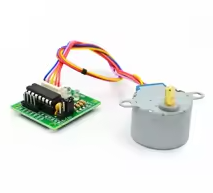
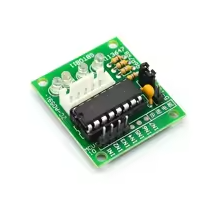
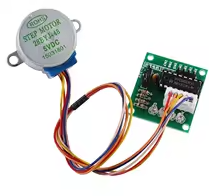
28BYJ-48 Stepper Motor + ULN2003 Driver Board Kit
5V 4-Phase Stepper Motor and Driver for Arduino DIY Projects
This kit includes a 28BYJ-48 5V stepper motor and a ULN2003 driver board, offering a complete, affordable solution for adding precise motion control to Arduino projects. It is ideal for robotics, automation, and educational applications [citation:3][citation:8][citation:10].
Complete & Affordable Kit Includes motor and driver board for precise, lowcost motion control
64:1 Gear Reduction - Provides high torque for driving mechanical loads
The motor's 5V power requirement makes it compatible with common microcontrollers, but an external power supply is recommended as the Arduino's 5V pin may not supply sufficient current [citation:8].
For simple wiring, connect the motor's 5wire cable to the driver board's 5pin socket, and the driver's control pins (IN1IN4) to Arduino pins 811 for use with the Stepper library.
Technical Specifications
| Parameter | Value |
|---|
| :- | :- |
| Motor Model | 28BYJ-48 [citation:1][citation:3][citation:5] |
| Driver IC | ULN2003 [citation:1][citation:5][citation:11] |
| Motor Voltage | 5V DC [citation:1][citation:3][citation:5] |
| Number of Phases | 4 [citation:1][citation:3][citation:5] |
| Step Angle | 5.625° [citation:1][citation:3][citation:5] |
| Gear Reduction Ratio | 1/64 [citation:1][citation:3][citation:5] |
= Key Features =
- Directly Pluggable - Standard interface for simple connection to the driver board [citation:3]
- Builtin LED Indicators Four LEDs on the driver board show the status of each motor phase [citation:5][citation:8][citation:10]
- ULN2003 Driver Chip - Provides the necessary current to drive the motor coils [citation:1][citation:5]
- Simple Step Control Sequences of digital signals sent to IN1IN4 pins control the motor's rotation [citation:2]
- Halfstep and Fullstep Modes - Offers flexibility between torque and smoothness [citation:8]
= Common Applications =
- Robotic arms, small actuators, and precise positioning devices [citation:10]
- Camera sliders and pan-tilt mechanisms [citation:10]
- Educational demonstrations and learning about stepper motors [citation:8][citation:10]
- Automation projects requiring controlled movement [citation:10]
Easy to Use Plugandplay design with standard interfaces makes it beginnerfriendly [citation:3][citation:8].
Versatile Power - Can be powered with a 5V or 9V external supply [citation:2][citation:6][citation:7].
√ Works with Arduino, Raspberry Pi, and other microcontrollers [citation:10].
√ Pre-wired motor cable and screw terminals for quick connection.
Troubleshooting
Motor not running:
- Verify 5V power is connected to the driver board [citation:3][citation:5].
- Check the signal wires (IN1-IN4) are correctly connected to your microcontroller [citation:4].
- Ensure the power supply can provide sufficient current (e.g., 1A) [citation:4].
Motor vibrates or stalls:
- Motor may be drawing too much current; use an external power supply [citation:8].
- Check code for correct step sequence and timing.
- Ensure the motor is not mechanically obstructed.