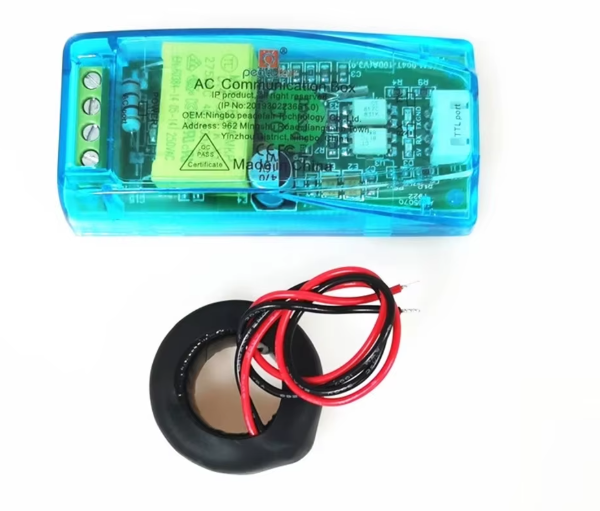
PZEM-004T AC Digital Multifunction Meter Module
TTL Serial Power Monitoring for Arduino and ESP Projects
The PZEM004T is an AC digital multifunction meter module that measures voltage, current, active power, power factor, frequency, and active energy via TTL serial communication. It is designed for integration with Arduino, ESP8266, ESP32, and other microcontrollers for realtime power monitoring projects.
Comprehensive AC Power Monitoring - Measures voltage, current, power, frequency, power factor, and energy in a single module.
100A HighCurrent Capacity Supports up to 100A current measurement with included current transformer (CT) and 80-260VAC wide operating range.
Communication is via TTL serial interface using Modbus-RTU protocol (V3.0) [citation:7][citation:12].
Available in variants: 10A built-in, or 100A with closed/open CT [citation:8].
Use the PZEM004T V3.0 with ModbusRTU libraries for reliable data reading and CRC checksum verification [citation:7].
Technical Specifications
| Parameter | Value |
|---|
| Voltage Range | 80-260VAC |
| Current Range | Up to 100A (with CT) |
| Active Power Range | 0-23kW |
| Frequency Range | 45-65Hz |
| Power Factor Range | 0.00-1.00 |
| Active Energy Range | 0-9999.99kWh |
| Measurement Accuracy | 0.5% (voltage, current, power) |
| Communication Interface | TTL serial |
| Communication Protocol | Modbus-RTU (V3.0) [citation:7] |
| Operating Temperature | -10°C to 60°C [citation:12] |
= Key Features =
+TTL Serial Communication Read and configure parameters via serial port with ModbusRTU protocol [citation:5][citation:7].
+Over Voltage Alarm Builtin alarm function for voltage monitoring [citation:2][citation:4].
+Energy Counting with Reset - Active energy measurement with reset capability via onboard button or serial command.
+Wide Voltage Range Operates on 80260V AC, suitable for standard household and industrial AC systems.
+High Accuracy - 0.5% measurement accuracy for voltage, current, and power readings [citation:6][citation:11].
= Applications =
- Real-time AC power monitoring with Arduino, ESP8266, and ESP32.
- Home automation and energy consumption tracking.
- Industrial equipment power measurement and IoT integration.
- Solar power system monitoring and data logging.
- Smart meter prototyping and educational projects.
PlugandPlay Monitoring - Simple TTL interface for direct microcontroller integration.
V3.0 Upgrade - Improved resolution, more samples per second, and increased stability over older versions [citation:6].
√ Available in 100A and 10A current variants [citation:8].
√ Compatible with ESP8266/ESP32 via MicroPython libraries [citation:7].
√ TTL interface works at 5V logic levels.
Connection and Usage Tips
For basic wiring:
- Connect 5V power supply to the module.
- Connect the CT (current transformer) to the AC line.
- Connect module TX to microcontroller RX, RX to TX.
- Use the V3.0 version for Modbus-RTU communication [citation:7].
For ESP32 projects, verify the module's TTL voltage level is compatible; some models require level shifting.
The V3.0 version provides better stability and resolution compared to older V1.0 [citation:6].
The module is designed for indoor use and may not measure power direction (import/export) [citation:10].
Troubleshooting
No data received:
- Verify TTL connections (module TX to MCU RX, module RX to MCU TX).
- Check correct voltage supply (5V).
- For V3.0, ensure Modbus-RTU protocol and CRC16 checksum are implemented [citation:7].
Inaccurate current reading:
- Ensure the CT is properly clamped around the correct AC wire.
- Check CT type matches the module (100A closed/open CT) [citation:8].
Data stops after some time:
- Check power supply stability.
- Some modules may have quality issues; verify with a multimeter [citation:5].








 2.jpg "Buy AD8232 Analog Heart Rate Pulse Sensor (ECG) kit for KSH 1,500 – HIMASTORES Mombasa – Quality electronics in Mombasa, Kenya")