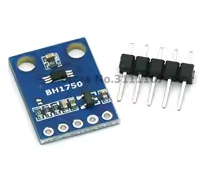
BH1750FVI light intensity illumination module for arduino 3V-5V
KSH 400.00
Out of Stock
The BH1750FVI is a digital ambient light sensor IC that provides a direct digital output in lux (lx), eliminating the need for complex analog calculations required by photoresistors [citation:1][citation:2]. The module is widely used in projects such as weather stations, smart home systems, and automatic display backlight adjustment, as its spectral sensitivity closely matches the human eye's response to light [citation:1][citation:3].
| Parameter | Value |
|---|---|
| :- | :- |
| Supply Voltage | 3V to 5V DC |
| Operating Current | 200µA [citation:1] |
| Measurement Range | 1 to 65,535 lux [citation:1][citation:4] |
| Resolution | 1 lux [citation:1] |
| Communication | I2C [citation:1][citation:2] |
| Chip | ROHM BH1750FVI [citation:1][citation:4] |
| Module Size (GY-302) | 13.9 x 18.5mm [citation:6] |
= Key Features =
+High Precision Measurement Detects light intensity with 1lux accuracy across a wide brightness range.
+Low Power Consumption Ideal for batterypowered projects with a typical current draw of 200µA [citation:1].
+I2C Interface Simple 2wire connection to microcontrollers, saving GPIO pins [citation:1][citation:4].
+Direct Digital Output - Outputs data in lux (lx), simplifying programming [citation:2].
+Spectrally Close to Human Eye - Provides accurate readings that match human visual perception [citation:1][citation:3].
+Builtin 16bit ADC No complex analogto-digital conversion or calibration is required [citation:1][citation:2].
√ Compatible with 5V and 3.3V Arduino, ESP32, and other microcontrollers.
√ Onboard level shifting for direct 5V I/O connection [citation:1].
√ Multiple I2C address options for use with multiple sensors on the same bus [citation:4].
| Module Pin | Arduino UNO Pin | Description |
|---|---|---|
| :- | :- | :- |
| VCC | 5V | Power supply (3-5V) [citation:1] |
| GND | GND | Ground [citation:1] |
| SDA | A4 | I2C Data line [citation:1][citation:4] |
| SCL | A5 | I2C Clock line [citation:1][citation:4] |
| ADD | GND / VCC | I2C address selection pin [citation:4] |
> Connect the sensor's VCC pin to the Arduino's 5V pin and the GND pin to the Arduino's GND pin [citation:1].
BH1750 library available through the Arduino IDE Library Manager for easy operation [citation:1].